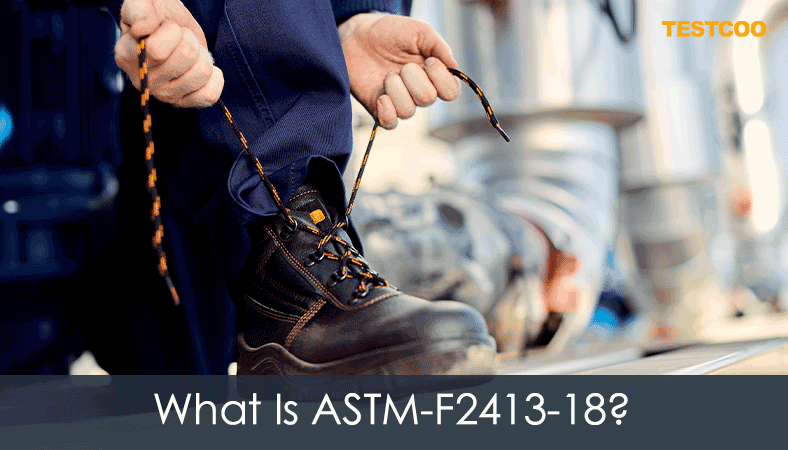
According to the Bureau of Labor Statistics, each year there are more than 53,000 foot injuries in U.S. workplaces that cause employees to miss work. Some result in permanent disability. Protective footwear – along with job design and/or workplace design – is an important means of preventing occupational foot injuries.
In the workplace, it is critical to wear protective footwear to guard your feet against potential threats like heavy objects falling on them or walking on sharp nails.
The ASTM F2413-18 is a standard that covers the minimum design, performance, testing and classification requirements, and prescribes fit, function and performance criteria for footwear designed to be worn to provide protection against a variety of workplace hazards that can potentially result in injury. It does not serve as a detailed manufacturing or purchasing specification, but it can provide a reference for purchasers that foot protection meets minimum performance requirements are met.
What Are Safety Footwear Regulations?
Safety footwear regulations are a set of rules and guidelines that dictate the type and quality of footwear allowed to be worn on the job. These rules exist to protect workers from potential hazards, such as falling objects, chemical spills, electrical shocks, and other dangers.Numerous kinds of safety footwear regulations exist, yet one of the most prevalent in the United States is produced by the American Society for Testing and Materials (ASTM).
The ASTM has two documents covering footwear safety: ASTM F2413 and ASTM F2412. In this article, we’ll look at the ASTM F2413-18 used for protecting footwear.
What Does Safety Toe ASTM F2413-18 Mean?
The ASTM F2413-18 is a standard that defines the minimum design, classification, performance, and testing requirements for protective footwear used in the workplace. Buyers can use the standard as a reference to ensure that the footwear meets the minimum performance requirements set by the ASTM.Footwear that has met the requirements of the ASTM F2413-18 standard will, in principle, be protected from various workplace hazards, including punctures, scrapes, cuts, and burns.
What Are the Requirements for ASTM F2413-18?
For footwear to conform to the ASTM F2413-18 specifications, it must meet the performance requirements for the following:-ASTM F2412-18a Section 5.2 for Impact ResistanceDuring the impact resistance testing of the toe area, a minimum interior height clearance of 11.9 mm for women and 12.7 mm for men.-ASTM F2412-18a Section 5.3 for Compression Resistance
The compression resistance should have a minimum interior height clearance of 11.9 mm for women and 12.7 mm for men.
In addition to these requirements, the footwear must meet the additional sections, including electric shock resistance, conductive protection, metatarsal protection, puncture protection, chain saw cut resistance, dielectric insulation and static dissipative (SD) properties.
Every piece of footwear that is manufactured according to the ASTM F2413-18 specifications must be marked/labelled.
All protective footwear that claims to meet the requirements of ASTM F2413-18 must have a test report and Certification of Conformance (COC) issued by a third-party laboratory.
The Certificate of Conformance needs to include the following information:
-The name, contact details and signature authorization of the third-party lab.
-Company name.
-Manufacturer’s product specifications, including category, style, model and SKU.
-Date of Certification Issuance.
-Report number and the issue date of the COC.
-A statement confirming that the manufacturer meets the performance requirements and a list of the safety hazards tested.
Conclusion: What Is ASTM-f2413-18?
The ASTM F2413-18 standard sets the requirements for protective footwear used in the workplace. Footwear that has met the requirements of this standard will, in principle, protect the employee from various workplace hazards, including punctures, falling objects and chemical spills.Testcoo would be happy to help you ensure that your manufactured footwear meets all of the necessary safety standards. Our experts can provide technical guidance with protective footwear inspection checklists, testing requirements and help you ensure compliance with all ASTM requirements. Contact us today to learn more about our footwear testing services.
评论
发表评论